
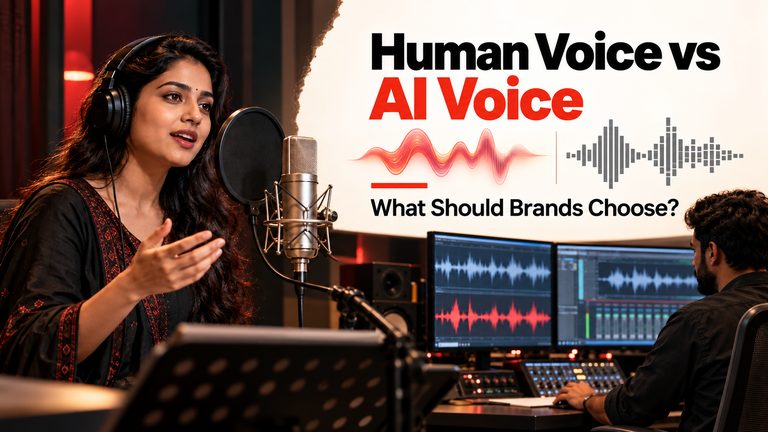
Human Voice vs AI Voice: What Should Brands Choose?
Published by FrameBuzz Media
The choice between human voice and AI voice is no longer simply traditional versus modern. Both can support professional content when used for the right purpose. The better question is: which approach fits the audience, emotional requirement, volume, deadline and risk level of your project?
What is human voice production?
Additionally, human voice production involves casting a suitable artist, directing the performance, recording in a controlled environment, and editing audio. Moreover, the artist can respond to context, adjust emotion and interpret subtle changes in meaning. This makes human performance especially valuable for storytelling, advertising, character work and sensitive communication.
What is AI voice production?
AI voice production uses a licensed synthetic voice or an authorized voice model to convert text into speech. Modern systems can produce clear narration quickly and support revisions without booking another recording session. Quality varies by language, voice, platform and the preparation of the script.
Human voice vs AI voice: key differences
Emotional performance
A skilled voice artist can understand subtext, humour, hesitation and emotional progression. AI voices are improving, but longer dramatic performances may still sound inconsistent or overly controlled. For a brand film, advertisement or character-led narrative, human direction often delivers a more memorable result.
Speed and revision flexibility
AI can be efficient when scripts change frequently or a large volume of narration is required. Correcting one sentence may take minutes rather than arranging a new artist session. Human recordings can also be fast, but artist availability and studio coordination affect turnaround time.
Cost at scale
For a short flagship video, the cost difference may be less important than performance quality. For hundreds of training modules, product updates or internal explainers, AI can reduce repeat recording effort. Costs should still include script preparation, pronunciation control, audio editing, quality checks and licensing—not only generation.
Pronunciation and language quality
Both workflows need review. Human artists may need guidance for brand names or specialised terms. AI voices can mispronounce names, numbers, abbreviations and code-switched sentences. Indian-language content requires particular attention to natural rhythm, regional usage and English terms within local-language scripts.
Rights, consent and brand safety
Human voice contracts should define usage, duration and territories. AI workflows must also use voices with clear commercial rights. A real person’s voice should never be cloned without explicit informed consent covering the permitted use. Brands should ask vendors how voice data, models and project files are protected.
When should a brand choose a human voice?
- Emotion and trust are central to the message.
- The content includes characters, humour or dramatic storytelling.
- The brand needs a distinctive long-term voice identity.
- The script contains complex pronunciation or frequent code-switching.
- The project is a high-visibility campaign where performance matters more than volume.
When can AI voice be a practical choice?
- Large quantities of informational content must be produced quickly.
- Scripts are updated regularly.
- The narration is functional and emotionally neutral.
- Several draft versions are needed before final approval.
- A controlled, licensed voice is available in the required language.
Why a hybrid workflow often works best
Brands do not need to apply one method to every asset. A human artist can record the flagship campaign while approved AI voices support high-volume explainers or temporary versions. AI may also be used for timing tests and internal approvals before the final human recording. The decision should be made content by content.
Whatever the method, professional review remains essential. Audio must be checked for pronunciation, pacing, noise, loudness, timing and synchronization with visuals. FrameBuzz Media supports both human and AI-assisted voice production, with editing and quality control handled as part of the delivery process.
A simple decision checklist
Before choosing, ask:
- How emotionally expressive must the narration be?
- How many minutes, languages and future updates are expected?
- What level of pronunciation control is required?
- Are commercial rights and voice consent documented?
- Who will review the final audio in every language?
Choose the workflow around the content
The right voice is the one that makes the message feel clear, credible and natural to its audience. Contact FrameBuzz Media to compare human, AI or hybrid options for your video, e-learning, advertising or multilingual content project.